Use case
First-party data, collected with consent
Sign-ups, enquiries and purchases are the data you own. Velo attaches a consent state to each visit, so your tags know whether that data may be used for advertising before they send it.
Examples on this page use sample data. This is not legal advice.
Your own data still needs a yes
Collecting an email address on your own form does not settle what you may do with it. Sending it to an ad platform, even hashed, depends on what the visitor allowed. The consent state has to be known at the moment the form is sent.
What goes wrong
- Hashed emails go to ad platforms whatever the visitor chose.
- Server side events lose the consent state on the way.
- Forms and consent are handled by different teams, and nobody joins them up.
What Velo does
- Sets ad_user_data, the Consent Mode signal Google checks before it uses data you send for advertising.
- Updates the signal as soon as a visitor chooses, on every page.
- Shares one choice across your subdomains, so the shop and the blog agree.
- Keeps a receipt for each decision that you can look up later.
From the form to the ad platform
Four moments in one sign-up, and who does what at each.
- The choice
A visitor allows or refuses advertising
Velo sets ad_user_data and ad_storage to match, on that page and every later one.
- The form
They sign up
Your form sends the details to your own systems. Velo is not involved and never reads them.
- The tag
Your Google tag checks the signal
With ad_user_data granted it adds the hashed email to the conversion. With it denied, the email is not used for advertising.
- The record
Velo keeps the decision
The receipt shows what was allowed and when, if anyone asks later.
A trial sign-up with enhanced conversions
A software company measures trial sign-ups in Google Ads with enhanced conversions, which add a hashed email to the conversion.
Illustrative example with sample data, not a customer story.
The visitor allowed advertising
The Google tag sees ad_user_data granted and includes the hashed email with the conversion. Velo never reads the form. The tag does that, and Velo only tells it what is allowed.
The visitor rejected
The form still works and the account is still created. The Google tag sees ad_user_data denied, so the email is not used for advertising. Google may model the conversion in eligible accounts.
Where it lives in Velo
Velo shares one choice per domain, gives your tags an event and keeps a record.
Get for freeOne choice across your subdomains
A choice made on www is read on shop and app under the same domain, so a visitor is not asked twice. Separate domains each ask on their own.
A consent event your tags can use
Every time consent takes effect, Velo pushes velo_consent_update to the data layer with the categories allowed. Use it as a trigger in Google Tag Manager for tags that have no consent setting of their own.
Proof for each decision
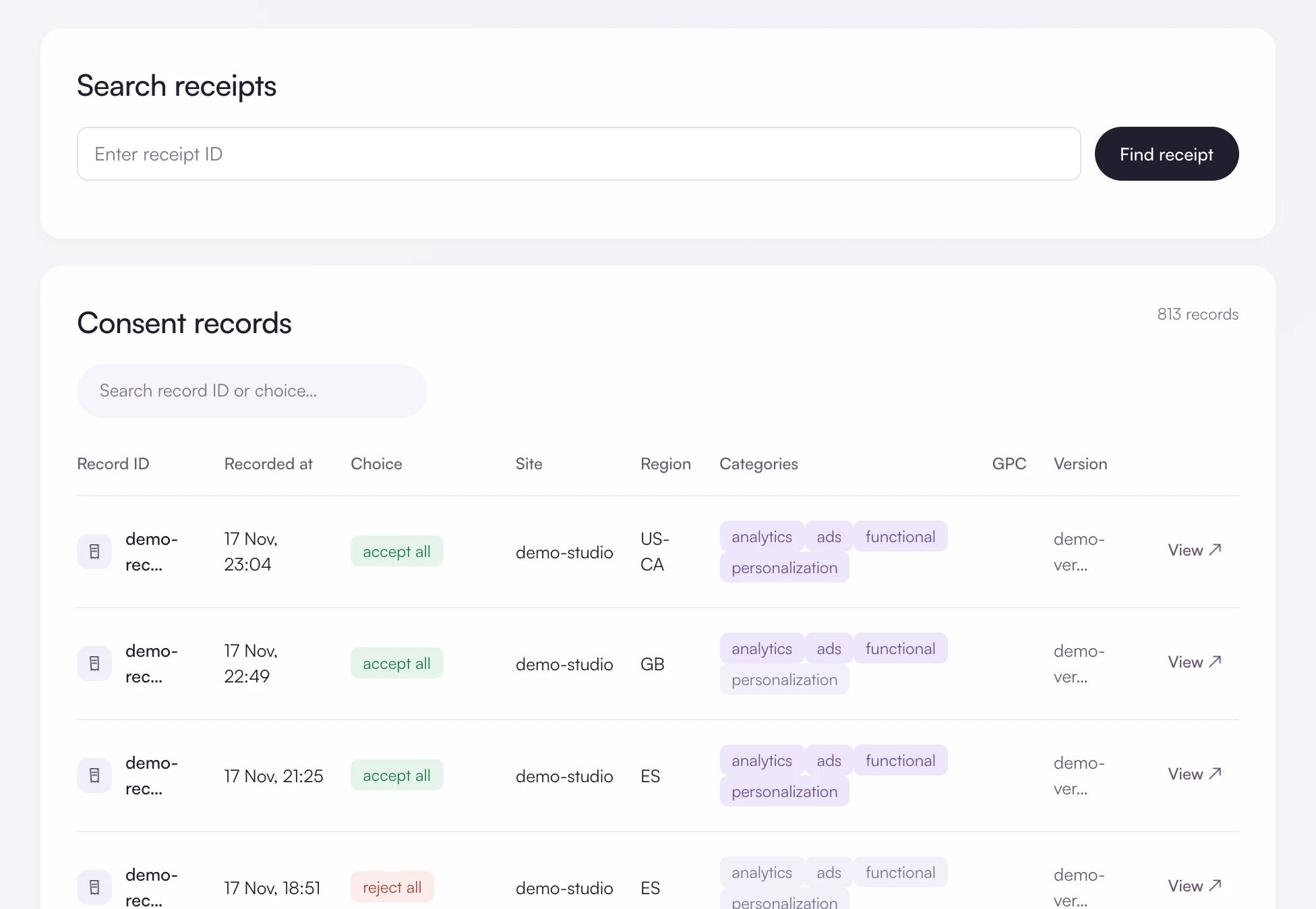
Consent records keeps the receipt, time, country, categories and banner version for every decision, without the visitor’s IP address.
What Velo covers, and what it does not
The limits, stated plainly, so you can decide before you install anything.
Questions and answers
Does Velo collect first-party data for me?
No. Your forms, shop and analytics collect it. Velo supplies the consent state those tools check before they use it.
Does consent follow a visitor who logs in on another device?
No. A choice is stored in the browser it was made in. A new browser or device shows the banner again.
Does Velo work with server side Google Tag Manager?
Yes, with one thing to know. You set up Consent Mode in the web container, which the Velo CMP template does. Server tags for other vendors do not follow it automatically, so add a consent rule to each.
Free for one site
Banner, scan and consent records for one site, free. Pro from €7 a month, plus VAT, for unlimited sites.