Industry
Cookie consent for gaming sites
For studio sites, web shops and community pages with players in every region. Velo covers the website only. It has no SDK for games, consoles or mobile apps, and no age check.
Examples on this page use sample data. This is not legal advice.
A player’s path on launch day
A game studio’s site has a trailer, a wishlist button, a web shop on a subdomain and pixels for Meta and TikTok campaigns. Follow one player in Brazil.
Illustrative example with sample data, not a customer story.
- The ad
A trailer ad on social
The player taps through from a campaign. Nothing has been set on the studio’s site yet.
- The site
The banner, in their language
Velo reads the country and the browser language, so a player in Brazil gets an opt in banner in Portuguese.
- The wishlist
A click you can measure
If analytics was allowed, the click is measured in full. If not, Google Analytics gets a cookieless ping.
- The shop
The same choice on the subdomain
The web shop on a subdomain reads the choice the player already made, so they aren’t asked again.
A launch brings the whole world to one page in a day. Each player should meet the default their country expects, in a language they read.
One banner behaviour does not fit every player
A trailer drops and players arrive from dozens of countries, most of them from social and video ads. The site measures wishlist clicks, pre-orders and newsletter sign-ups, and every one of those tags needs the right default for the country the player is in.
What goes wrong
- One banner behaviour for players in Germany, Brazil and Texas.
- User acquisition pixels fire before a choice in opt in regions.
- The banner shows in English to everyone.
What Velo does
- Applies opt in or opt out from each visitor’s country.
- Shows the banner in the player’s browser language, from 14 languages.
- Sets Consent Mode v2 for Google tags and passes the choice to the Meta Pixel and Microsoft UET.
- Shares one choice across subdomains such as the shop and the forum.
The same launch, region by region
Here’s what the studio’s site does in four countries, and what its tags receive once a player accepts.
The default each player meets
Players in Germany and Brazil choose before any optional tag runs. Players in the United States and Japan get the opt out default, with a clear Reject, unless the studio sets those countries to opt in.
After a player in Brazil accepts
Google and Meta tags receive the grant. The TikTok Pixel gets no consent signal from Velo, so the studio marked its script as advertising and Velo releases it now. The shop on a subdomain reads the same choice.
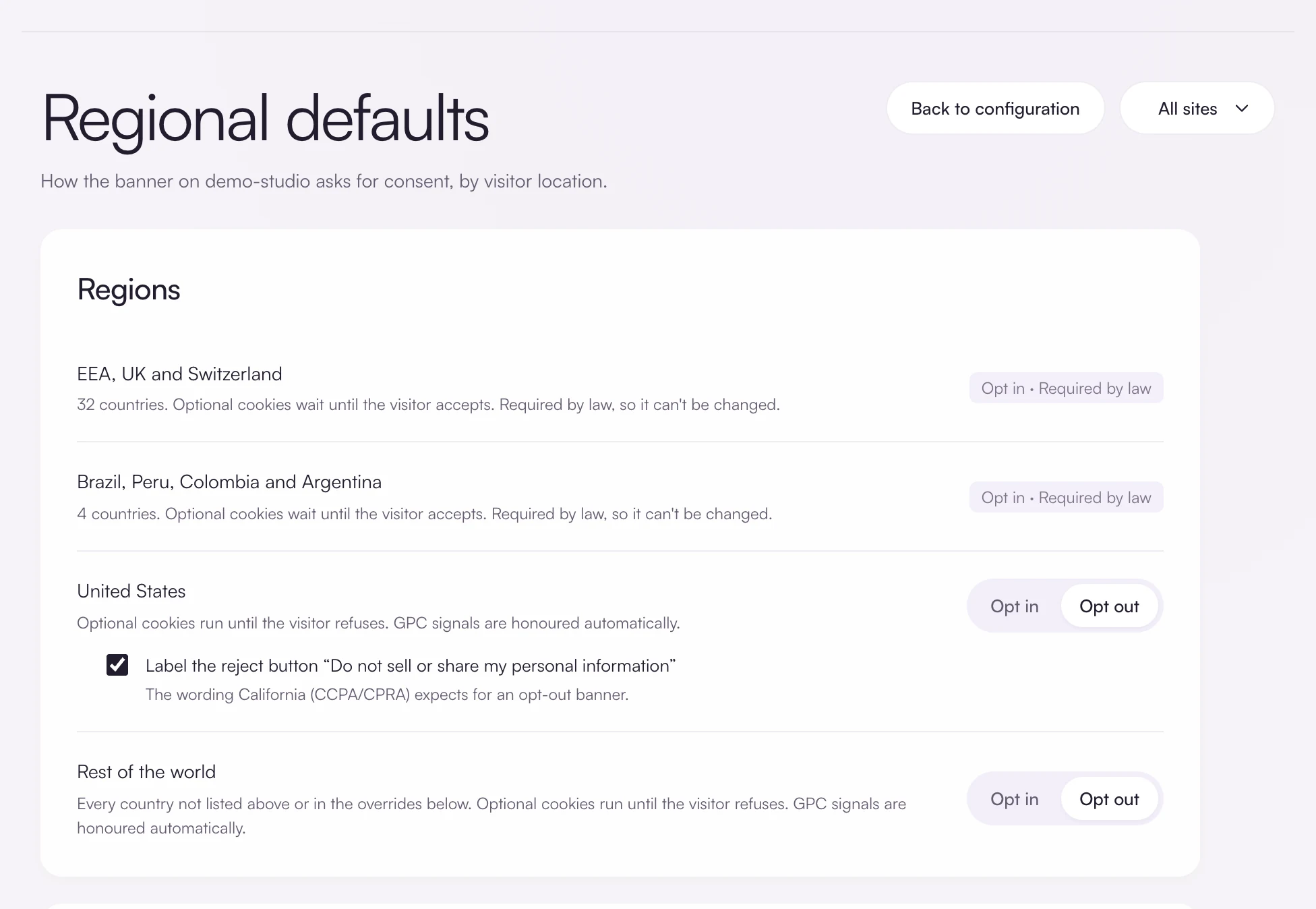
Check the default in each region
Opt in is locked across the EEA, the UK, Switzerland, Brazil, Peru, Colombia and Argentina. For the United States and the rest of the world the default is opt out, and you can switch either to opt in.
Write the banner once per language
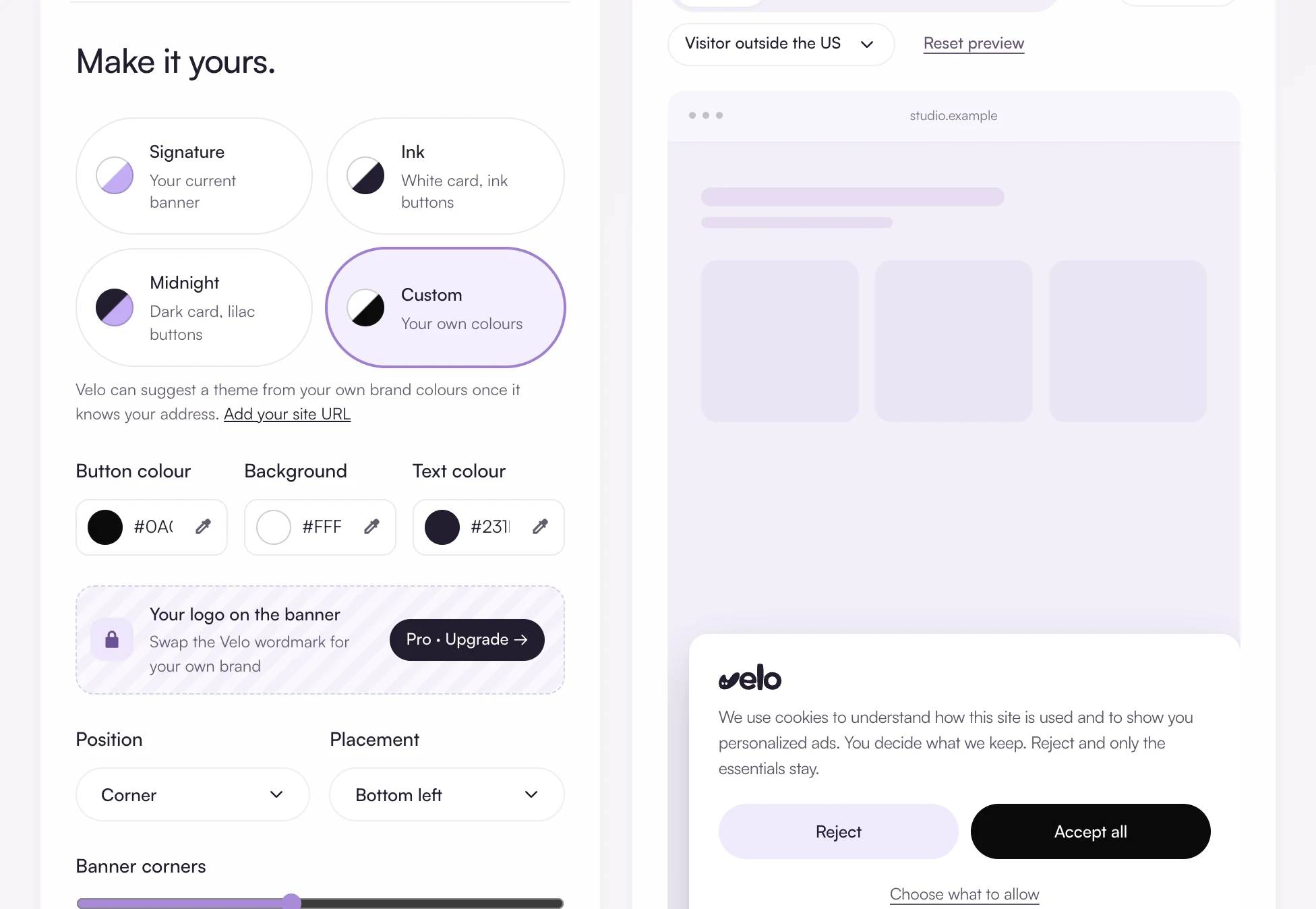
Enable the languages your players read and edit the wording for each. Velo picks one from the player’s browser.
What Velo covers, and what it does not
The limits, stated plainly, so you can decide before you install anything.
Questions and answers
Does Velo work inside a game or a mobile app?
No. Velo is a consent layer for websites. It has no SDK for game engines, consoles, mobile apps or connected TV.
Can Velo check a player’s age?
No. Velo has no age gate or parental consent flow. Laws on children’s data may apply to your site, and meeting them needs tools Velo does not provide.
Does Velo make my website compliant?
No tool can promise that. Velo gives you a banner with a real choice, regional defaults, consent signals for your tags and a record of each decision. Whether your whole setup meets the law depends on what your site does with data, which is for you and your advisers to assess.
Free for one site
Banner, scan and consent records for one site, free. Pro from €7 a month, plus VAT, for unlimited sites.